


Understanding Tax Rates
WE NEED YOUR HELP!
Lobby99 is a nonprofit that depends on the support of our readers.
If you found this useful, could we ask you to chip in a dollar or three to help us provide even more like this? Thanks!
It's secure and takes under a minute.
Trump reverses savings on mortgage premiums
| 2017-Jan-20 | By: Rob Dennis |
One of Donald Trump's first actions as president will cost some homebuyers an average of $500 this year.
Trump issued an administrative order shortly after taking office to suspend an upcoming cut in the Federal Housing Administration's (FHA) mortgage insurance premium (see our preceding story).
The move will increase costs for more than 750,000 borrowers, according to the National Association of Realtors.
FHA mortgages are popular among low- and moderate-income borrowers because they require a lower downpayment and are more favorable to buyers with lower credit scores.
Private insurance companies compete with FHA to issue mortgage insurance premiums. Reversing the Obama administration's proposal to reduce the rates is likely to help those private insurers, according to Bloomberg.com
For more, read the Bloomberg.com story.
Click here to read the National Association of Realtors analysis of the impact on homebuyers.
FHA insurance price cut will save homeowners hundreds
| 2017-Jan-09 | By: Barry Shatzman |
The average homeowner whose loan is insured through the Federal Housing Administration (FHA) will save $500 in 2017, as the FHA will reduce the Mortgage Insurance Premium they pay.
The FHA also reduced premiums in 2016, saving affected homeowners an average of $900.
Department of Housing and Urban Development (HUD) Secretary Julian Castro said in a press release that the reduction was possible because the agency has enough to cover future claims.
For more, read the CNN Money story.
Senate approves letting states collect sales tax from online retailers
| 2013-May-07 | By: Barry Shatzman |
The Senate has passed a bill that would allow states to force large online retailers to collect state and local sales tax. It would affect only those retailers who have out-of-state sales of more than $1 million annually.
The law would help traditional in-person businesses, which typically are at a pricing disadvantage against online businesses because they must charge sales taxes.
In some states, residents still are required to pay sales tax for online purchases even if the retailer does not charge it. State tax forms provide a place to declare those purchases - though many simply ignore it with no direct consequences.
Five states - Alaska, Delaware, Montana, New Hampshire, and Oregon do not have a state sales tax - relying on income and property taxes instead.
The bill still needs to be passed by the House of Representatives before being sent to the president to sign.
For more, read the New York Times story.
The bill is S-743: Marketplace Fairness Act. To find out more about it click here.
Obama budget hits Social Security and middle class hardest
| 2013-Apr-15 |
The budget released on April 10 by President Obama would have direct effects on most Americans - especially those with low incomes. Seniors would feel the effect in Social Security, when annual increases fail to provide them with the same purchasing power as before. Middle-class Americans would pay more in taxes.
Both effects stem from changes in how the cost of living is calculated - measured by the Consumer Price Index (CPI).
There actually are several Consumer Price Indexes - each measuring the cost of living for different groups of people. The proposed budget would change which of these measurements are used to calculate benefits and tax rates.
This chart shows how each of the measurements of the cost of living has changed since 2000...
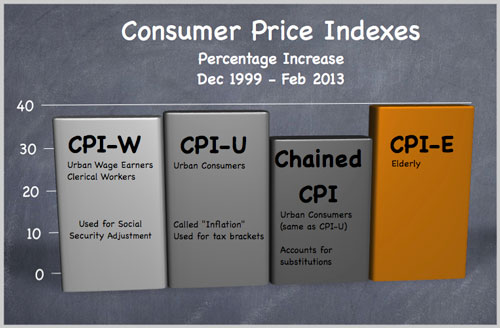
The differences seem relatively small, but they add up to real money. Because the Chained CPI has risen by a smaller percentage, increases in Social Security benefits based on that index will be smaller than if linked to CPI-W, as it currently is. In fact, the reduction would cost the average retired worker more than $500 each year, according to figures from the Social Security Administration.
But the difference actually is harsher than that. Because a large percentage of their expenses go toward health care, seniors don't have the flexibility to alter their choices in ways the Chained CPI assumes. Note the gold bar at the right of the graph. That's the actual increase in the cost of living for seniors, according to the Bureau of Labor Statistics.
In short, seniors are losing purchasing power even if things stay the same. If increases are reduced by using the Chained CPI, their lives will be hit even harder.
A deeper understanding of how the Social Security system works reveals that these reductions not only will hurt seniors, but they won't provide any benefit to the overwhelming majority of Americans. Lobby99 will explain this in a separate discussion we will publish in the future.
Social Security isn't the only thing that would be based on the Chained CPI in the president's proposed budget.
As we explained in our discussion of marginal tax rates, you pay a different percentage of tax on different portions of your income (tax brackets). The income boundaries for those brackets increase each year based on the cost of living. That increase is based on CPI-U. If that becomes based on the Chained CPI, the brackets would increase less - exposing money at the top of the new brackets to higher rates.
Click here to see how that would work.
The tax increase would not be very large - around $100 a year for most families. As a percentage of income, however, people earning between $20,000 and $50,000 would feel the biggest impact, according to the Tax Policy Center.
Once approved, the budget would take effect on October 1 - the start of the next fiscal year. The president's budget is just one proposal. The House of Representatives also has proposed a budget, as has the Senate. Of course, the final budget will not look exactly like any of the proposals. Lobby99 just wants you to understand the issue so you can determine how well your representative is representing you.
For more on the effects of using the Chained CPI, read this article in The Nation.
For a quick summary of the entire budget proposed by the Obama administration, read this Washington Post story.
This ABC News report lists some of the more obscure provisions in the proposed budget.
Figures on the effect of using the Chained CPI to adjust tax brackets come from the Tax Policy Center.
Congress approves bill to raise taxes, delay automatic cuts
| 2013-Jan-02 |
Congress has reached a last-minute deal to avoid the so-called "fiscal cliff" - raising taxes on couples making more than $450,000 a year, extending unemployment benefits and delaying automatic spending cuts for two months.
The Senate passed the bill 89-8 early New Year's day and the House approved it 257-167 less than 24 hours later. President Barack Obama has said he will sign the bill into law.
The deal:
o Raises the marginal tax rate to 39.6 percent. The rate had been 35 percent since 2003.
o Permanently raises capital gains and dividend taxes from 15 percent to 20 percent
o Permanently raises the estate tax rate from 35 percent to 40 percent (for amounts over $5 million)
For individuals who earn less than $400,000 (and couples earning less than $450,000)...
o Extends the Bush-era tax cuts - making the current rates permanent
o Extends unemployment benefits for a year.
The bill also...
o Delays the automatic across-the-board spending cuts known as the "sequester" for two months.
o Extends the current farm bill for nine months, averting a hike in milk prices.
o Extends the earned income tax credit, child tax credit and college tax credit for five years.
o Permanently indexes the Alternative Minimum Tax for inflation to avoid tax hikes on the middle class.
o Prevents for a year a 27 percent cut in Medicare payments to doctors.
For more, read the New York Times story
Would eliminating deductions solve our financial issues?
| 2012-Dec-05 |
President Obama has proposed allowing the Bush-era tax cuts to expire (as originally planned in 2001). This would return the highest marginal tax rate on couples earning more than $250,000 a year to 39 percent (the Bush tax cuts had reduced that rate to the current 35 percent). It likely would generate more than $950 billion in revenue.
Most congressional Republicans refuse to support any budget plan that would allow the Bush-era tax cuts to expire. They have proposed raising $800 billion over the same time period by limiting deductions for the wealthiest taxpayers. One analysis shows that such revenue would be possible, but it would involve eliminating deductions such as those for home mortgage interest, charitable deductions, and state taxes.
You can read more about the analysis in this New York Times article.
Obama and Boehner propose competing "Fiscal Cliff" proposals
| 2012-Dec-04 |
House Republican leaders have countered President Barack Obama's proposal to tackle the looming "fiscal cliff."
If Congress doesn't pass a new tax policy by the end of 2012, when the Bush-era tax cuts that were extended in 2010 are set to expire, rates will return to pre-2001 levels.
Obama last week proposed raising an additional $1.6 trillion over 10 years, $960 billion of which would come from the expiration of the Bush-era tax cuts for those earning more than $250,000 a year. The proposal also calls for extending the 2010 payroll tax "holiday" and for taxing dividends the same as ordinary income.
Obama's plan also proposes saving $400 billion in Medicare expenses.
House Speaker John Boehner and other Republican leaders countered Monday with a proposal that aims to raise $800 billion in new revenue. The additional revenue would come from eliminating deductions for those earning more than $250,000 a year. It would extend the Bush-era tax cuts for the wealthiest Americans.
The Republican proposal would slice $600 billion from federal health programs, in part by increasing the Medicare eligibility age from 65 to 67.
For more information on President Obama's proposal, see this New York Times report.
For more on Rep. Boehner's proposal, see this Washington Post report
The New York Times has compiled a graphic comparing the two proposals.
Congression Research Service pulls Tax Rate Report
| 2012-Nov-01 |
The Congressional Research Service has withdrawn a report which concluded that low tax rates on the wealthiest Americans have contributed to the shrinking wealth of 95 percent of Americans.
For more, read the New York Times article.
The report, issued in September, was criticized by several Republicans for reasons including...
o The author of the report contributed to the Democratic Party and worked as an economist at the White House budget office during the Clinton administration.
Both of those criticisms are factually correct, yet they do not invalidate the report.
The first criticism could potentially challenge the argument that lowering tax rates on the richest 1 percent of the population increases their wealth at the expense of the poorest 95 percent. However, the criticism also provides no evidence that shifting the parameters would contradict that argument.
Most important, it presents no evidence that lowering tax rates on the wealthy would benefit the overwhelming majority of Americans in any way.
The second argument merely highlights the need to consider the source of any study. However, as any author of any study will have some political leaning one way or another, that alone never is a reason to dismiss a finding on the basis of who wrote it. Rather, it needs to be evaluated on the merits of its data. This particular report is based on official statistics that are not in dispute.
You can download a copy of the report by clicking here.
This National Review editorial reflects the opposition to the report expressed by several Republicans.
For an understanding of what a marginal tax rate is, click here
For information on the Congressional Research Service, click here.